
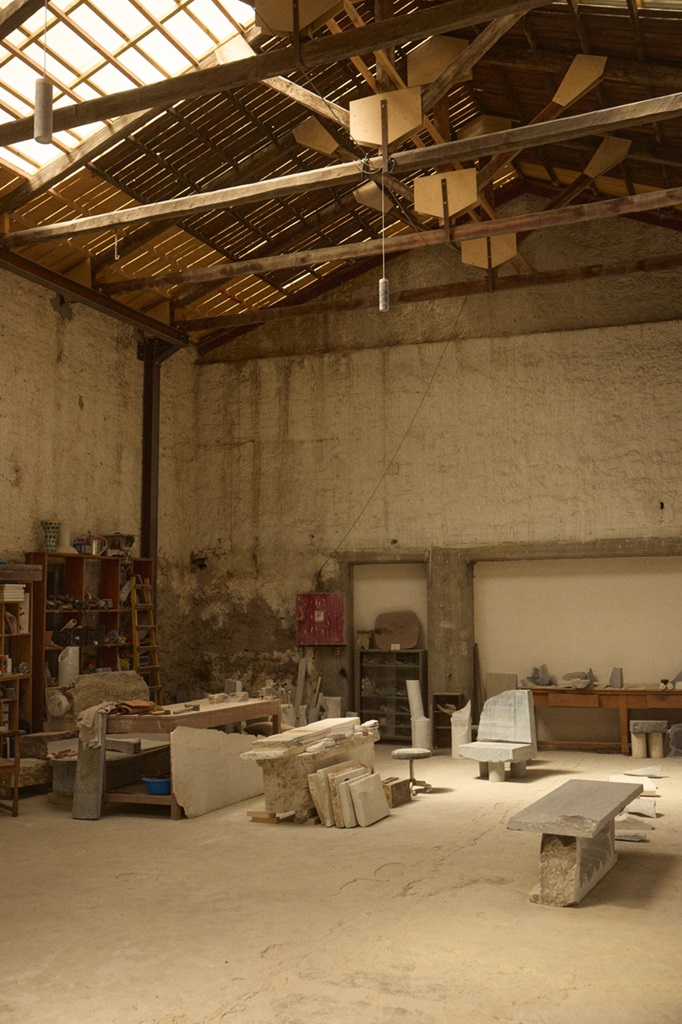
Entering his studio, I find him drenched in marble dust, carving. This atelier is special. It is a former ouzo distillery near the port of Piraeus, Greece.
Moving through his marble compositions, the raw walls of the space, combined with the partially transparent ceiling, create a mystical setting that changes depending on the sunlight.
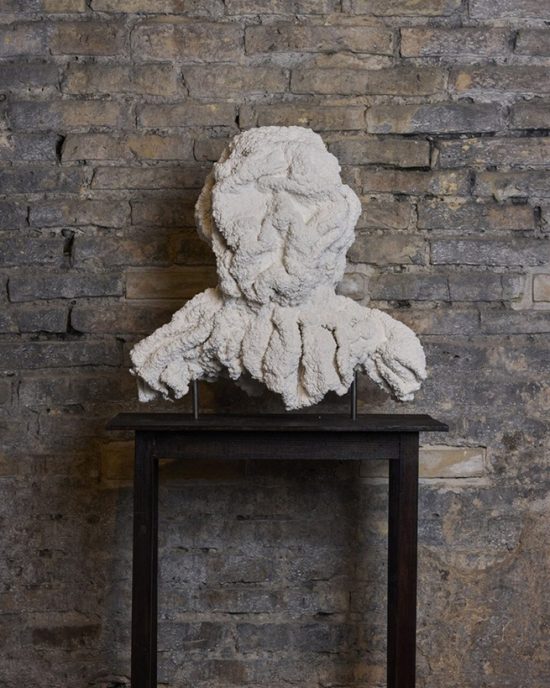
There, Theodore Psychoyos spends most of his day, creating with his hands functional marble objects, such as stools, benches, tables and chairs, that bring into dialogue smooth surfaces and massive rocks. These monumental pieces of furniture, stripped of any notion of decorative excess, have the charm of the raw, of heaviness but also of durability, concepts that derive from the marble itself as a material.
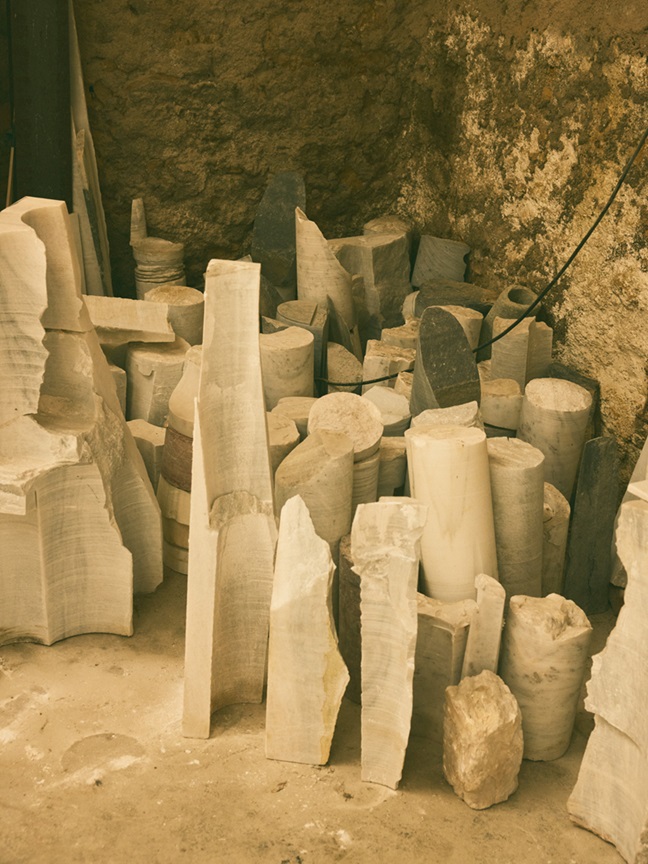
“I started working with marble very young, when I was still a student at the School of Fine Arts in Paris. Along the way, I abandoned it to pursue painting and music. In recent years, I have re-evaluated my relationship with it. I began to be concerned with the particular way in which the craftsmen and machines of the 1920s, 1930s, 1940s and 1950s in Greece treated marble blocks. With the development of technology, the marbles of that era fell into disuse. I attempt to give them new life. I find value in something that someone no longer pays attention to and considers surplus. I am fascinated by the traces of people, machines and time that these rocks bear on them,”
There is, of course, a deeper meaning behind his decision.
“I wanted to confront the concept of matter,” he emphasizes. “Gravity keeps us connected to the earth, to reality, in an era when everything is now virtual. If you want to look at it more philosophically, my engagement with matter is a process that I have consciously put myself through in order to face my death. I am not saying that I will die tomorrow. However, the realization that I am also a fragile matter, like a marble, frees me. Every day I immerse myself in matter, physically and psychologically. I carry huge volumes, I process them, I enter entirely into the process. The main interest for me through this work that I do is to learn how I will die. It is a study in the process of decay.”

Theodore speaks Greek with a French accent. He have spent his childhood in Paris, in a large family of Greek immigrants who met in Piraeus during World War II and sought a better life in France, studying Medicine. He is the seventh child in the family and the only son, having six older sisters. This may also explain the uniqueness of his multifaceted personality. From the way he speaks to the way he moves, Theodore’s idiosyncratic, bohemian nature is hard to ignore.

He initially studied Law at the Sorbonne, since he always had a sense of justice that he wanted to explore further, but art turned out to be his great love. “I wasn’t interested in making a career in anything specific. All I wanted was to be good at whatever I did, he says. I was and am curious, in the sense that I was always interested in learning about different aspects of this life. I grew up in an art-loving home. The Pompidou was being built next to my school and I was one of the first visitors. In my family, the disagreements we had were more about a work of art than anything else” he recalls, looking back at the freedom he felt when he decided to enter the School of Fine Arts.
If there’s one thing he enjoys most about what he does, it’s creating with his hands.
“I’m excited by the state a person enters when they create something with their hands. It takes on a rhythm of its own, like diving into a calm sea or praying, I’m not concerned with making beautiful things. What is beautiful, anyway? Who can define it clearly? For me, beauty is about tranquility as well as a sense of rebellion.”
In recent years, he has lived between Athens and Paris and recently started thinking about opening another studio in Syros. “If you find a place where people greet your dog with a smile on the street, then you can stay there,”he believes. “I like Athens because it is heterogeneous, unlike Paris where you see more or less the same thing. There is a strong element of surprise in Athens, just like in New York. This makes it special and attractive to many people in the arts worldwide.” He undertakes work in every part of the world, creating with marble that he finds in each place. His last major collaboration was for a restoration project of a historic hammam in Turkey, where he had the opportunity to get to know Oriental art better. He does not have high hopes for the future. He chooses to focus on the present. “My life is similar to the way I work in the studio. I give space for things to just happen, without imposing anything.”
– Vlasis Kostouros
Photographer: Vassilis Karidis
Fashion Editor: George Karapetis
Source: Vogue Greece
Transcreation by Panagiotis Margaritis